
Yesterday we spent the afternoon in the university departmental museums, the Sedgwick, the Archaeology and Anthropology, and the Zoology. Today we came back for the other half of Cambridge: the colleges themselves, the churches, the Fitzwilliam Museum, and the river Cam. The weather was fine, which suited a day spent mostly on foot and outdoors.
The thing that makes Cambridge different from most universities is how it is put together, and it helps to know that the structure has changed over time. For the first six hundred years, the colleges were the university. There was no central organization to speak of. Each college was a self-contained world: it housed its students, fed them, and taught them, one fellow sitting with two or three students in a room, working through the material face to face. The university itself was little more than an examining body that set the tests and awarded the degrees. All the real teaching happened inside the colleges.
That changed in the nineteenth century, when the sciences outgrew what any single college could provide. A chemistry laboratory, a physics workshop, a medical school, these needed space and equipment no college dining hall could hold. So the central university expanded. It built lecture theatres and laboratories, hired its own teaching staff, and organized them into departments and faculties grouped under six broad schools: Arts and Humanities, Biological Sciences, Clinical Medicine, Humanities and Social Sciences, Physical Sciences, and Technology. Today there are over 150 departments. The newer universities that grew up in the same period were built on this department model from the start. Cambridge kept both systems running side by side.
So today a student at Cambridge belongs to two things at once. A department is where you study your subject, attend lectures, and do your research, the way any modern university works. A college is where you live, eat, socialize, and still receive that old form of small-group teaching, now called a supervision, typically two or three students with a tutor, still considered one of the best teaching methods in the world. There are 31 colleges, each self-governing, each with its own land, buildings, income, and rules. Some are old and very rich: Trinity, founded by Henry VIII, is wealthier than many small countries. Some are recent and modest: Robinson was founded in 1977. They range from Peterhouse, the oldest, founded in 1284, to colleges that did not exist when the people who teach in them were born. Twenty-nine of the thirty-one admit undergraduates.
When you walk through Cambridge and see the grand gatehouses and courts and chapels, you are looking at the colleges, not the university. The university has no single campus. Its departments are scattered through the city, in lecture halls and laboratories that sit among and between the colleges. The colleges are the physical face of Cambridge, and it is the colleges you visit.

We arrived in town around ten and started at the Round Church, properly the Church of the Holy Sepulchre, on Bridge Street. It is a small building, easy to walk past, tucked on a corner where it has been since about 1130. It is one of only four medieval round churches still standing in England. The round shape is not decoration. It was built by a group called the Fraternity of the Holy Sepulchre, who modelled it on the rotunda of the Church of the Holy Sepulchre in Jerusalem, the site where Christ was said to have been buried and risen. The First Crusade had taken Jerusalem in 1099, and in the decades that followed, round churches inspired by that building appeared across western Europe. Cambridge got its own about thirty years later.


The church is no longer a working parish. It is run as a visitor centre, and inside, arranged around the circular nave and its heavy Norman columns, there is an exhibition that walks through the history of Cambridge alongside the history of Christianity in England. It runs from the Romans and the Saxons through the medieval church and the founding of the university, through the Renaissance and the Reformation, the break with Rome, the rise of the Puritans and the smashing of church windows and images, through the Enlightenment and the age when science and faith began to pull apart, and into the modern era. At each stage it shows what was happening in the town at the same time. It is told from a Christian perspective and does not pretend otherwise, but as a compressed walkthrough of a thousand years of English history with Cambridge as the thread, it covers a great deal of ground in one small room.
The exhibition made something clear that stays with you for the rest of the day, as you walk past the colleges and think about Newton and Darwin. The colleges were not built for science. They were built for the Church. The medieval university existed to train clergy, and the colleges were religious foundations, endowed by bishops and monarchs to house scholars who were, in most cases, ordained or preparing to be. Every college has a chapel at its heart, and that is not an ornament; it is the reason the college was there. For over six hundred years Cambridge taught theology, classics, and mathematics. Natural sciences did not become a formal examination subject until 1848. Before the word “scientist” even existed, there were only “natural philosophers,” and it was a Cambridge man who gave science its name. In 1833, at a meeting of the British Association for the Advancement of Science held in Cambridge, the poet Samuel Taylor Coleridge, old and frail, dragged himself to the hall and insisted that the members should not be called “natural philosophers” because they were not philosophers. William Whewell, a reverend and fellow of Trinity, suggested “scientist,” by analogy with “artist.” The word stuck. Before Whewell, there was no English word for what a scientist was. Whewell did not stop there. He also coined “physicist,” and invented the words “anode,” “cathode,” and “ion” for his friend Michael Faraday. One man in one college gave the language half the vocabulary of modern science. It is said that Darwin left England on the Beagle in 1831 as a “natural philosopher” and returned in 1836 as a “scientist,” not because of anything he did at sea but because while he was away, Whewell invented the word for what he was.
The shift from religion to science was not a clean break. At Cambridge, for a long time, they were the same project. The professors who built modern geology and biology were ordained clergymen of the Church of England who believed that studying nature was studying the work of God. Adam Sedgwick, who named the Cambrian period, was a reverend. Henslow, the botanist who trained Darwin, was a reverend. Whewell was a reverend and the Master of Trinity. For them, a microscope and a pulpit served the same end.
Cambridge was also where the English Reformation took intellectual shape. In the 1520s, before Henry VIII had any quarrel with Rome, a group of Cambridge scholars began meeting at a pub called the White Horse Inn to read and discuss the writings of Martin Luther, newly arriving from Germany. The pub became known around the town as “Little Germany.” The men who gathered there included Thomas Cranmer, who would become the first Protestant Archbishop of Canterbury and write the Book of Common Prayer; Hugh Latimer and Nicholas Ridley, who would both be burned at the stake under the Catholic Queen Mary; and William Tyndale, who translated the Bible into English and was burned for it. When Henry VIII later needed a theologian to justify his break with Rome over his marriage to Catherine of Aragon, he turned to Cambridge and found Cranmer. The break itself was the king’s doing, driven by his need for a divorce the Pope would not grant, but the intellectual ground for it had been prepared in Cambridge, in a pub, by men reading Luther.
From there we walked south along the college fronts. St John’s College has one of the most elaborate gatehouses in Cambridge, a Tudor facade in red brick covered in heraldic shields. Over the entrance is carved the coat of arms of its founder, Lady Margaret Beaufort, the mother of Henry VII, the first Tudor king, and one of the most powerful women in fifteenth-century England. She used her wealth to reshape Cambridge, founding two colleges, Christ’s and St John’s. She died in 1509, and St John’s received its royal charter in 1511, two years later, brought into being largely through the efforts of her chaplain John Fisher, the Bishop of Rochester. Fisher would later be executed by Henry VIII for refusing to accept the king as head of the Church. We had hoped to go in. The Bridge of Sighs is inside, spanning the Cam between the old courts and the nineteenth-century New Court, and can only be seen from within. The college was closed to visitors that day. We saw the gatehouse and moved on.


Next door, Trinity College, the largest and richest college in Cambridge. Henry VIII founded it in 1546 by merging two older colleges, in the same years he was dissolving the monasteries and breaking the English Church from Rome; the college is itself a product of the Reformation. We could not go in either, so we stood at the Great Gate and looked into the Great Court, the largest enclosed courtyard in Cambridge, the one where the race against the clock in Chariots of Fire was set. Across Trinity Street from the Great Gate stand the Gothic buildings of Whewell’s Court, named after William Whewell and built with his money. Inside the college, in the Ante-Chapel, his statue stands alongside Newton’s, one of six statues of Trinity’s great men carved in marble. The man who gave science its name and the man who defined what science could do, side by side.
Trinity is Newton’s college, and his story tells you a great deal about the place. Newton entered in 1661 as a sizar, a poor student who paid his way by serving the wealthier ones, carrying their meals and cleaning their rooms. He went on to hold the Lucasian Chair of Mathematics from 1669, at the age of twenty-six, and to produce the Principia, the foundation of modern physics, in this college. But as a fellow of Trinity he was required to take holy orders, to be ordained a priest of the Church of England. Newton held private religious views that did not fit Anglican orthodoxy. Rather than swear to orders he could not honestly take, he applied to King Charles II for a special dispensation. In 1675 the king granted it, exempting the Lucasian professor, and all future holders of the chair, from the requirement. Newton kept his fellowship and kept doing science, but it took a royal decree to let him. Three centuries later, Stephen Hawking held the same Lucasian Chair, from 1979 to 2009. The same professorship, the one that needed a king’s permission to exist outside the Church, running from the age of the Restoration to the age of black holes.
By the gate, on the street side, stands a descendant of Newton’s apple tree, grown from the original at his family home in Woolsthorpe, Lincolnshire. Whether Newton really watched an apple fall and thought about gravity in the way the story tells it is debated. The earliest version comes from Newton himself, told to a friend late in life. The tree is real enough, a graft from the Woolsthorpe original, and it draws a crowd. Whether it is a genuine relic or a well-placed piece of theatre is up to you. We took the photograph and did not overthink it.


A few steps further down, between Trinity and King’s, sits Gonville and Caius College, known simply as Caius, pronounced “Keys.” It is the fourth-oldest college in Cambridge, founded in 1348, and it has produced fifteen Nobel laureates of its own. Two people tie it to the history of science three centuries apart. In the 1590s, William Harvey studied medicine here before going on to discover the circulation of blood, overturning a theory that had stood since the ancient Greeks. In the twentieth century, Stephen Hawking was a fellow of Caius for fifty-two years, from the early days of his career until his death in 2018, working on the physics of black holes and the origin of the universe from this college, in a wheelchair, for half a century. There is nothing of either man to see inside, no memorial, no display. Hawking’s ashes are not here; they were interred at Westminster Abbey, between Newton and Darwin. But we took a picture of the gatehouse and the college front, because this was Hawking’s address for longer than most people live in any one place, and Harvey’s before him.


We walked on to Great St Mary’s, the University Church, facing the market square on King’s Parade. The church itself is fifteenth century and plain inside. We came for the tower. We paid, climbed the narrow spiral staircase, and came out onto a viewing platform with a full 360-degree view of the city. King’s College Chapel was directly below, its long roof and pinnacles at eye level. The college roofs and courts spread in every direction. On a clear day it is the best single view of Cambridge.


We came down, crossed King’s Parade, and looked at the outside of King’s College from the street. King’s was founded in 1441 by Henry VI, who also founded Eton, the school that sent its boys here. The chapel dominates the street front, its perpendicular Gothic windows running the full length. We would come back to it later in the day.


We turned down Bene’t Street to the Eagle, the pub at number 8. This is where Francis Crick walked in on 28 February 1953 and announced that he and James Watson had found the structure of DNA. There is a blue plaque on the outside wall, and inside, in the middle room, two more plaques by the table where Crick and Watson had eaten lunch nearly every day while working on the problem. The 2023 plaque now names Rosalind Franklin and Maurice Wilkins alongside them, a correction that took seventy years. The pub also has the RAF Bar, whose ceiling was graffitied by Allied airmen during the Second World War, burning their names and squadron numbers into the plaster with cigarette lighters and candles. Cambridge has a history of things being worked out in pubs. The White Horse Inn in the 1520s, the Eagle in 1953.


From the Eagle it is a minute’s walk to Free School Lane and the site of the Old Cavendish Laboratory. James Clerk Maxwell founded it in 1874 as Cambridge’s first proper physics laboratory, and he was its first director. Maxwell had already unified electricity and magnetism into a single theory, one of the great achievements of nineteenth-century science, and the laboratory he built became the place where that tradition continued. In this one building, over the following eighty years, Thomson discovered the electron, Rutherford split the atom, Chadwick found the neutron, and Crick and Watson built their model of DNA. The building is still there, part of the university’s New Museums site, but it is no longer a physics lab. It is used for other purposes now, offices and teaching rooms. From the outside it does not look like anything at all. But there are plaques on the wall, and Free School Lane is a few hundred feet long, and that was the address where a good part of modern physics was done.


Standing in that lane, having walked from the Eagle and its DNA plaques past the Cavendish wall, the line from the Church to modern science runs very short. Darwin is the person who shows it most clearly. His father, a successful physician in Shrewsbury, sent him to Edinburgh at sixteen to study medicine. Darwin hated it. He could not stand the sight of operations, which in those years were done without anaesthesia, and left without a degree. His exasperated father, who once told him “You care for nothing but shooting, dogs, and rat-catching, and you will be a disgrace to yourself and all your family,” sent him to Cambridge to train as a clergyman, a respectable career for a gentleman’s son without direction. Darwin arrived at Christ’s College in 1828 to study theology. While there, he was supposed to be reading Paley’s Evidences of Christianity and preparing to take holy orders. Instead he fell in with the Reverend Henslow, who took him on botanical walks and introduced him to the Reverend Sedgwick, who took him on geological field trips. These two clergymen, not the theology lectures, gave Darwin his real education. And it was Henslow who, when the Beagle needed a naturalist in 1831, recommended the young theology student for the voyage that changed everything. The man who would write the most disruptive scientific work in history was trained by priests, inside a theology degree, at a university built for the Church.
By now we had walked past enough colleges and enough plaques to feel the weight of the place. Cambridge has produced, over eight centuries, a concentration of people who changed how the world is understood that is difficult to match anywhere. Newton worked out gravity and the laws of motion at Trinity. Darwin studied here before the Beagle voyage and sent his specimens back to his Cambridge teachers. Maxwell unified electricity and magnetism. Thomson found the electron in his laboratory, Rutherford split the atom, Chadwick found the neutron. Crick and Watson built the double helix a few streets away, drawing on the X-ray crystallography of Rosalind Franklin, who had studied at Newnham College, one of the two women’s colleges, and whose contribution was not acknowledged for decades. Hawking spent fifty-two years at Caius working on the physics of black holes. Alan Turing, who broke the Enigma code at Bletchley Park and laid the foundations of computer science, was a fellow of King’s; in the 1950s, one of the greatest minds the university had produced, he was prosecuted for his homosexuality, chemically castrated, and driven to his death. Cambridge honoured and excluded in the same breath. Harvey discovered the circulation of blood at Caius in the seventeenth century, overturning two thousand years of medical teaching. Fred Sanger, at St John’s and later King’s, won the Nobel Prize in Chemistry twice, in 1958 and 1980, one of only four people in history to win two Nobels, both times for working out the structure of molecules that carry life, first proteins and then DNA. Oppenheimer did postgraduate work here before leading the building of the atomic bomb. Dirac and Bohr, two of the founders of quantum mechanics, both worked here. Keynes reinvented economics. Wittgenstein and Bertrand Russell, both at Trinity, reshaped philosophy between them. Milton and Byron and Tennyson wrote poetry here. Cromwell studied here before overthrowing the king. Attenborough studied natural sciences at Clare. Fifteen British prime ministers came out of Cambridge. The university has produced over 120 Nobel laureates. Walking through these streets, the names are not abstract. They are on the gates and the walls and the plaques, and the buildings where they worked are the buildings you are walking past.
And until quite recently, all of those names were men. For over six hundred years no woman studied here. The first women’s college, Girton, was founded in 1869, placed deliberately on the outskirts of town, far from the men’s colleges. Women could sit the university examinations but could not receive degrees. In 1890 Philippa Fawcett scored higher than every man in the Mathematics Tripos, but because she was female she could not be named Senior Wrangler or receive the degree she had earned. Cambridge did not grant full degrees to women until 1948, the last university in Britain to do so. The names on the gates and the walls are almost all men’s names, and that is not an accident. It is the record of who was allowed in.
We crossed Trumpington Street to Pembroke College, the third-oldest college in Cambridge, founded in 1347 by Marie de St Pol, Countess of Pembroke, one of the earliest colleges founded by a woman. Its chapel was the first completed building designed by Christopher Wren, built in 1663 when Wren was still a young man and better known as a mathematician than an architect. Pembroke sits right next to the Fitzwilliam Museum. Peterhouse, the oldest college, founded in 1284, is just across the street; it was Peterhouse that sold the land the Fitzwilliam now stands on. We looked at Pembroke’s court and chapel, and then walked next door to the museum.


The Fitzwilliam Museum is a world-class art and antiquities museum, free, and it belongs to the University of Cambridge. It was founded in 1816, when Richard Fitzwilliam, the 7th Viscount Fitzwilliam of Merrion, an Irish nobleman who had studied at Trinity Hall, died and left the university his entire collection. That collection included 144 paintings, over 40,000 prints, a library of rare books and manuscripts, and £100,000 to build a museum to house them. The building that went up on Trumpington Street is itself a piece of architecture, with a grand colonnaded entrance hall and staircase that sets the scale before you see a single object. It opened to the public in 1848, thirty-two years after the bequest, and has been growing since. It now holds over half a million objects.
The founding wealth, the money that built the museum and bought the original collection, came in part from the slave trade. The Fitzwilliam family’s fortune flowed through the transatlantic trade in enslaved people, and the museum says so itself, openly, on its own walls. But the story of Cambridge and slavery does not end with the money. It was also at Cambridge that the movement to abolish the trade took shape. In 1785, a student at St John’s College named Thomas Clarkson entered a Latin essay competition on the question “Is it lawful to make slaves of others against their will?” He won the prize, read the essay aloud in the Senate House, and was so shaken by what he had found in his own research that he devoted the rest of his life to ending the slave trade. William Wilberforce, who would carry the cause in Parliament for decades, was also at St John’s. Peter Peckard, the Master of Magdalene College, had set the essay question and championed abolition from within the university. The University Senate sent anti-slavery petitions to Parliament in 1788 and 1792. Olaudah Equiano, the African former slave whose autobiography became a founding text of the abolitionist movement, visited Cambridge to sell his book and win support. Cambridge has been called the English hub of the abolition movement. The wealth from slavery built parts of the university, and people from the university helped bring slavery to an end. Both are true, and neither cancels the other.
The painting galleries upstairs were rehung in 2024, and the old chronological walk, Renaissance to Romanticism to Impressionism, is gone. The paintings are now grouped by subject across all periods: Nature, Interiors, Identity, Migration and Movement, and Men Looking at Women. A Picasso can hang a few metres from a painting two centuries older, connected not by date but by what both painters were looking at. It takes a moment to adjust. Among the paintings, two Titians stand out. His Venus and Cupid with a Lute Player, from the 1550s, is from the founder’s original bequest, part of the collection that started the museum. His Tarquin and Lucretia, painted in his eighties for Philip II of Spain, is a late and violent work, fully finished by Titian’s own hand. Both are among the finest Italian paintings in any British collection outside London. The Monet collection is strong, and there are works by Rembrandt, Canaletto, Degas, and Picasso spread across the themed rooms.
The ground floor holds the antiquities, arranged by civilisation. The Egyptian rooms are the deepest part of the museum. The centrepiece is the coffin set of Nespawershefyt, a five-piece set made around 1000 BC for a high official at the temple of Amun at Karnak. It consists of a mummy board, an inner coffin, and an outer coffin, each nested inside the next, and every surface is covered in painted religious scenes and spells from the Book of the Dead in brilliant colour. The world expert on Egyptian coffins has called it the finest surviving example of a 21st Dynasty coffin set anywhere. It was one of the first objects the museum ever acquired, given in 1822 by two Cambridge students who had travelled through Egypt. Around it, the galleries hold carved sarcophagi, painted coffin panels with the faces of the dead staring out across three thousand years, canopic jars that held the organs removed during mummification, and small carved figures called ushabti that were placed in tombs to serve the dead in the afterlife. The Greek and Roman galleries hold pottery from the black-figure and red-figure periods, marble and bronze sculpture, and a collection of Cypriot antiquities.


We left the Fitzwilliam and walked back up to King’s College Chapel. We had seen the outside earlier; now we went in. It was begun in 1446 under Henry VI and took the better part of a century to finish, which means the Reformation cut right through its construction. The interior is a single enormous room, long and high, with the largest fan-vaulted ceiling in the world spreading overhead in stone ribs that seem too fine to hold their own weight. The fan vault was completed between 1512 and 1515 by the master mason John Wastell. The stained glass, twenty-six large windows running the full length, was completed by 1531, and it is among the finest and most complete sets of medieval glass in England. That it survived is partly luck and partly protection: during the Civil War, Parliamentarian troops used the chapel as a training ground, but Oliver Cromwell, who had studied at Cambridge, is thought to have ordered the building spared. Behind the altar hangs Rubens’ Adoration of the Magi, painted in 1634, dark and enormous. The woodwork of the screen that divides the chapel, carved in the 1530s, carries the intertwined initials of Henry VIII and Anne Boleyn, a marriage that lasted three years and ended with her head on the block, but whose monogram is still here in the wood, five centuries later. Every surface in the chapel carries detail. We spent a long time looking up.


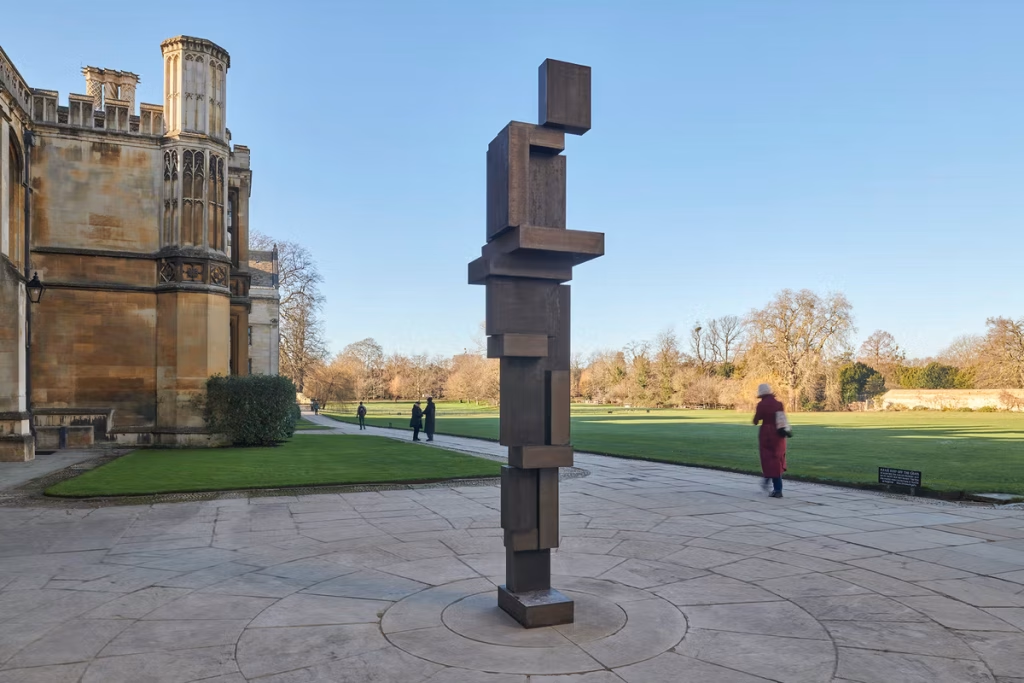
Inside the college grounds, between the Gibbs Building and Webb’s Court, stands a recent addition: a 3.7-metre sculpture in corten steel by Sir Antony Gormley, the artist who made the Angel of the North. It is called True, and it is a memorial to Alan Turing. Turing was a fellow of King’s in the 1930s. He broke the Enigma code at Bletchley Park during the war and laid the foundations of computer science with a paper he wrote while here. In front of the college, on the grass facing King’s Parade, there is also a blue plaque in his name. Turing was prosecuted in the 1950s for his homosexuality, which was then a criminal offence, and was subjected to chemical castration. He died in 1954, at forty-one. He received a royal pardon in 2013, nearly sixty years after his death. The Gormley sculpture, abstract and made of stacked steel blocks, is designed to rust slowly into a warm red over the years. It does not look like Turing. It looks like an idea of him, incomplete, still forming.
From the chapel we walked through to the back of the college, where the lawns run down to the River Cam. The name of the city comes from this river, but the name took the long way round to get there. In Anglo-Saxon times the river was called the Granta, and the town was Grantabrycge, meaning “bridge over the Granta.” Over the centuries the town’s name drifted, from Grantabrycge to Cantebrigge to Cambridge. Once the town was called Cambridge, people assumed the river must be called the Cam. So the river was renamed to match the town, not the other way around. Upstream, past Silver Street, the river is still called the Granta. The village of Grantchester, just south of town, keeps the old name too.
We had seen the punts from the bank and decided to take one. We hired a chauffeured punt for about an hour and a half and drifted along the stretch called the Backs, where the college grounds come down to the water. The punter poled us under the bridges one by one. Silver Street Bridge first, a plain road bridge. Then the Mathematical Bridge at Queens’ College, a wooden footbridge built entirely of straight timbers arranged to describe an arc. The story told to every tourist is that it was designed so cleverly it needed no bolts, and that students took it apart to see how it worked and could not put it back together without adding them. The story is a myth; it has always had bolts. Then King’s College Bridge, a stone arch from 1819, with the chapel rising behind it. Then Clare Bridge, built in 1640, the oldest surviving bridge on the Cam, its stone balustrade lined with decorative balls, one of which has a wedge missing. The story is that the builder, who was never fully paid, cut the wedge out and left his mark. Then Garret Hostel Bridge at Trinity Hall. Then Trinity Bridge, with the Wren Library standing on the bank behind it. Then the Kitchen Bridge at St John’s, from which the best photograph of the Bridge of Sighs can be taken. We had tried to see it from the street that morning, through a closed gate. From the river, there it was, the covered stone bridge connecting the old courts to the New Court, the one they named after its Venetian cousin. And finally under the Bridge of Sighs itself and on toward Magdalene Bridge, the last crossing, the one that was once simply called the Great Bridge. That is the original bridge over the Granta, the one that gave the town its name.


From the water the colleges show their other face. They front the street on one side and the river on the other, and from the punt you see the private side, the gardens and lawns and the backs of the buildings that the street never shows. The chapel at King’s, seen from the river with the afternoon light on it, looks like a different building from the one on King’s Parade.
We stepped off at the far end, walked back through the town, and caught the bus to Carioca. Two days in Cambridge, and we had not run out of things to see.
Discover more from Overlanding Travel Log
Subscribe to get the latest posts sent to your email.